
Power of attorney for use in India

Powers of attorney are the most common reason people in the diaspora need a consular signature. Property, banking, court proceedings and family matters all run on them, and the requirements come from the Indian side rather than the American one.
Two routes, and the receiving party decides
| Route | How it works |
|---|---|
| Executed at the consulate | You sign in front of a consular officer, who attests it |
| Notarised in the US, then apostilled | US notary, then the Secretary of State |
What it has to say
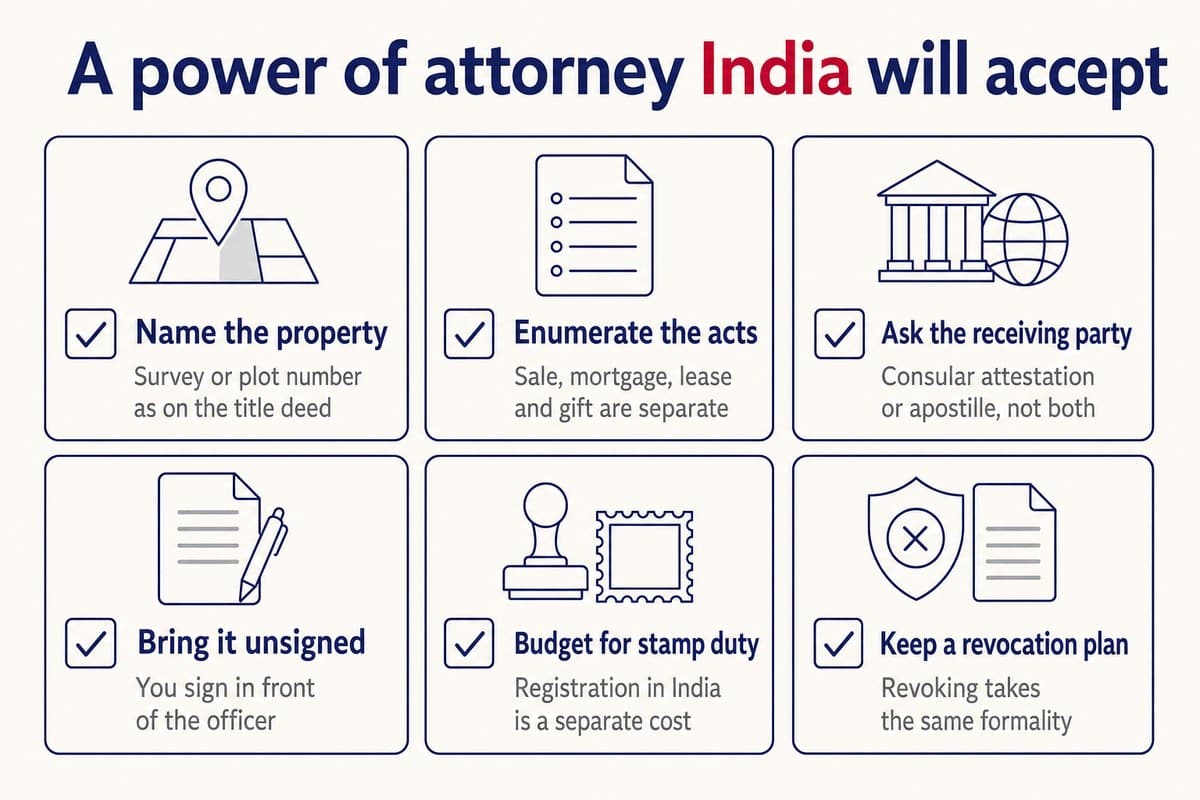
The powers granted have to be specific. A general power that says «manage my affairs» is routinely refused by sub-registrars, who want the property described and the acts enumerated.
Stamp duty and registration
Attested here is not the end of it. A power of attorney used for immovable property normally has to be stamped and often registered in India, and that is the receiving party's job to explain.
- Ask the Indian side which route they accept
- Draft it with the acts and the property named
- Bring your passport and the original draft, unsigned
- Two witnesses are often required; check first
- Budget for stamping and registration in India
The most common refusal
Sub-registrars in India refuse powers of attorney that describe the property loosely. Survey number, plot number, the registered description: whatever the title deed says is what the power should say.
The second most common refusal is a power that grants «all acts» without enumerating them. Sale, mortgage, lease and gift are treated as separate powers, and a document that does not name the one being exercised is not accepted for it.
Special and general, and why the distinction bites
A special power is for a named act on a named asset and is what most transactions need. A general power is broad, is treated with suspicion, and in several states attracts stamp duty as though it were a transfer.
Ask which one the receiving party wants before drafting. Redrafting after an attestation means attesting twice.
Revoking one
A power of attorney stays in force until it is revoked, and revoking it takes the same formality as granting it: a deed, attested the same way, and notice to the person who held the power and to anyone who relied on it.
Where the original was registered in India, the revocation is registered too. A revocation that exists only as a letter is not enough for a registrar.