
Life certificate for an Indian pension

An Indian pension paid to someone living abroad has to be reactivated every year with proof that the pensioner is alive. The consulate issues that proof, and for pensions it charges nothing for it.
Two versions of the same document
| Purpose | Fee |
|---|---|
| Pension | Free, plus $2 fund contribution |
| Anything other than a pension | The ordinary attestation fee applies |
The form the bank wants
Indian banks and pension authorities each have their own format. Bring theirs. A consular certificate in a general format is often bounced by the disbursing bank, and then the trip is repeated.
Timing
Most pensions run on an annual cycle with a window in November. Getting the certificate inside that window avoids the pension being suspended and then restored, which takes months.
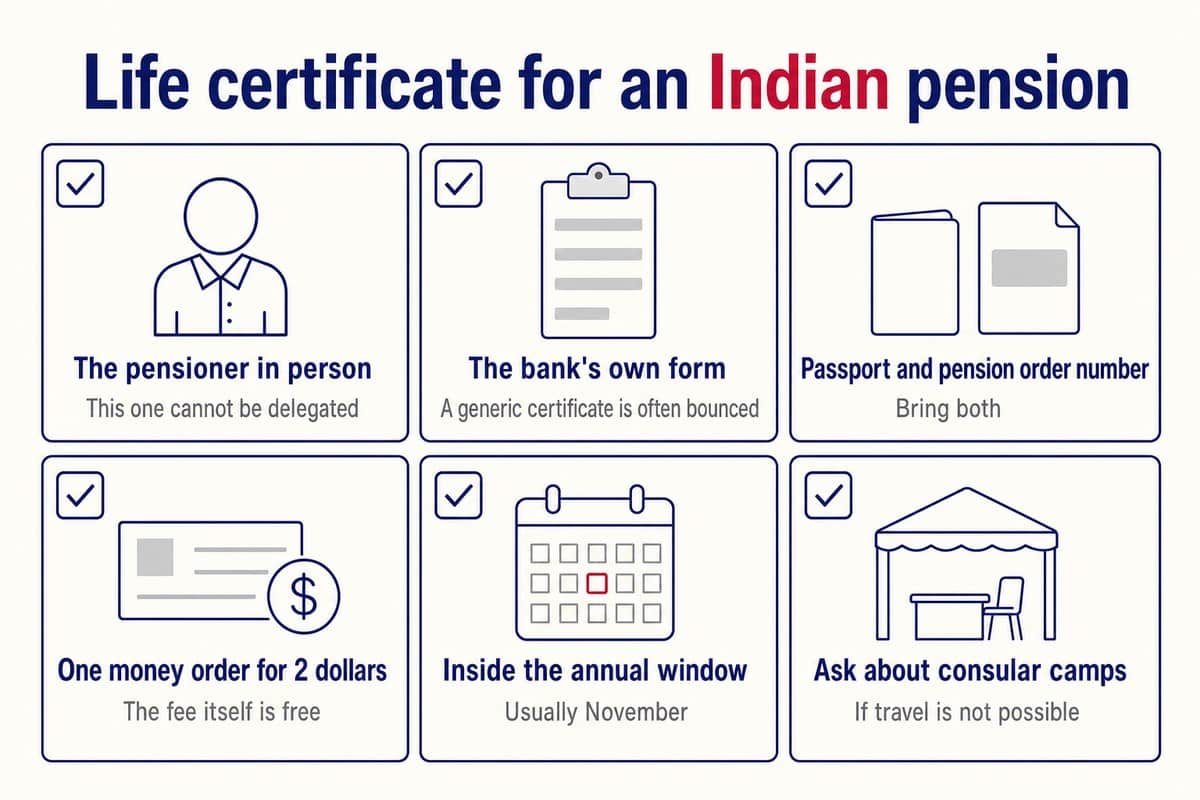
- The pensioner, in person
- The bank’s own form, not a generic one
- Passport and PPO or pension order number
- One money order for $2, made out to the fund
- Do it inside the annual window, usually November
Digital life certificates, and whether they apply to you
India has pushed a digital life certificate for pensioners inside the country, built on Aadhaar. Most NRIs cannot use it, because an Aadhaar needs 182 days of residence in India and a pensioner living abroad rarely has them.
That leaves the consular certificate as the practical route, which is why this small free service still matters.
If the pensioner cannot travel
Some consulates run consular camps in cities without an office, and a life certificate is among the services they take. Where no camp is scheduled and the pensioner genuinely cannot travel, ask the consulate directly rather than sending a representative, who will be turned away.
The bank in India can also accept alternatives in some cases. That is the bank's decision, not the consulate's, so ask them first.
What happens when the certificate arrives late
The pension is not cancelled. It is suspended, and the arrears are paid once the certificate is processed. In practice that means two or three months with nothing arriving, which for a pensioner living on it is the whole problem.
Banks differ on how quickly they restore payment. The ones that handle NRI pensions routinely are faster than a branch that sees one a year.