
Transporting ashes or mortal remains to India

Repatriating a body or ashes to India is a consular procedure, and it is one of the few where the consulate acts quickly and without an appointment in practice. It is also one of the few where the fees are published plainly.
What the consulate issues
| Service | Fee |
|---|---|
| Attestation of the accompanying documents | Free |
| Permit for transport of ashes | $42 |
| Permit for transport of mortal remains | $62 |
What is needed
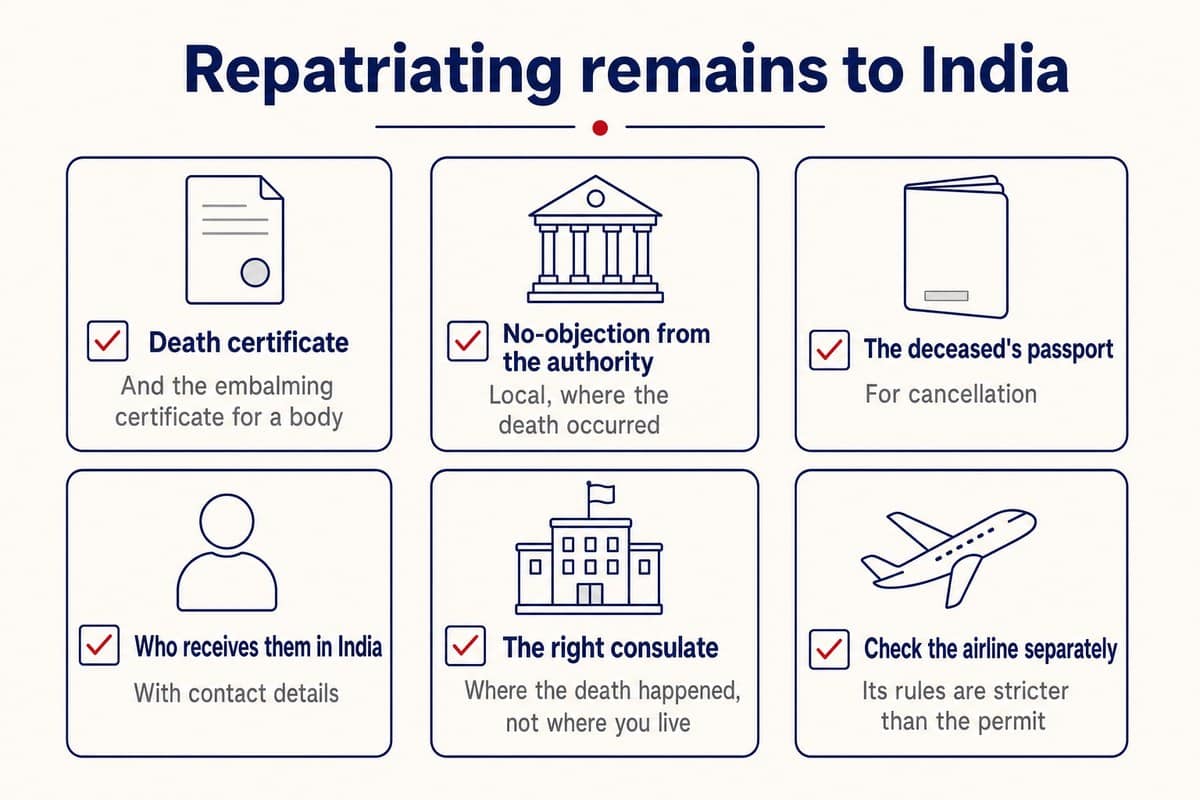
The death certificate, the embalming certificate where a body is being repatriated, the no-objection from the local authority, the cancelled passport of the deceased, and the details of the person receiving the remains in India.
The passport of the deceased
An Indian passport is surrendered and cancelled as part of this. Where the deceased had naturalised elsewhere, the surrender may already have happened and the certificate is what the consulate asks for.
- Death certificate and, for a body, the embalming certificate
- No-objection from the local authority
- The deceased’s passport, for cancellation
- Who is receiving the remains in India, with contact details
- Attestation is free; the permit is $42 or $62
Which consulate, and why it is not the one you expect
The office that acts is the one covering the place where the death occurred, not where the family lives or where the deceased was registered. In a country where one consulate can be sixteen hundred miles from another, that decision is worth getting right on the first phone call.
Funeral directors who have done this before will know. Ones who have not will default to the nearest consulate, which may be the wrong one.
Ashes, and what the airline needs
Ashes travel with the consular permit, the death certificate and the crematorium certificate. Airlines have their own rules on top, usually about the container and about carrying them in the cabin, and they are stricter than the consular requirement.
Check with the airline before the urn is sealed.
Insurance, and who pays for what
Repatriation is expensive and travel insurance often covers it, but the policies pay against invoices rather than in advance. The family funds it and claims afterwards, which is worth knowing on day one rather than day ten.
The consular fee is the smallest item on the bill by a wide margin.